
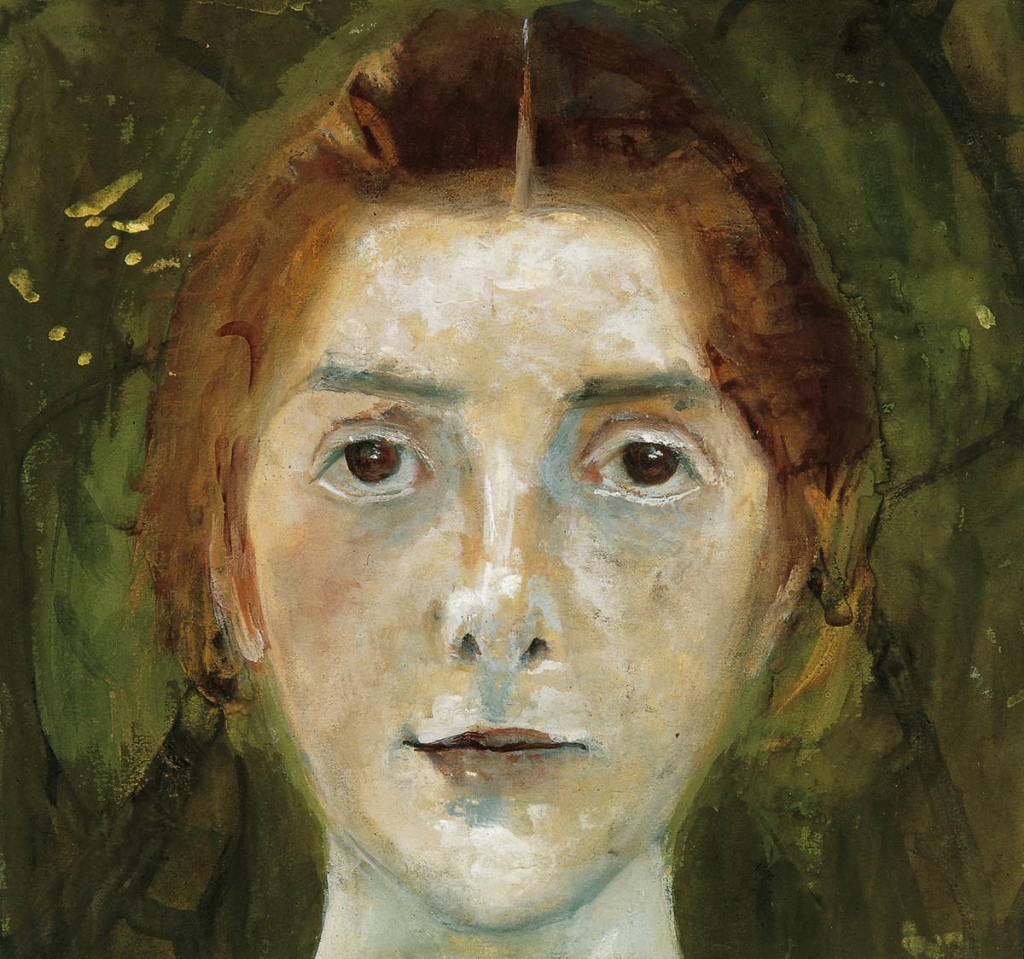
Paula Modersohn-Becker was one of the greatest female artists of the 20th century.
I first came across the work of Paula Modersohn-Becker as a young art historian. I was preparing an article on modern female artists. It was Paula Modersohn-Becker’s work that really hit me. I immediately placed her alongside Picasso. She was driven by the same passion and energy. And just like Picasso she possessed the same immense artistic power that was fully developed right from an early age.
However, Paula Modersohn-Becker almost went unnoticed. Why? Mainly because she was a female artist in a time when women had to stand at the side of her husband and look after their children. Another reason is that she died – as so many fantastic artists – at a very young age. She was only 31. She lived a short but intense life. It is rather eerie fact that she did foresee her destiny. Seven years before her death – in 1900 – she wrote in her diary: “….I know that I shall not live very long. But I wonder, is that sad? Is a celebration more beautiful because it lasts longer? And my life is a celebration, a short, intense celebration….And if only now love would blossom for me, before I depart; and if I can paint three good pictures, then I shall go gladly, with flowers in my hair…”
Paula had painted more than just three good pictures. She left us an immensely rich legacy that is most unconventional.
It was in Dresden in 1876 that Paula came into the world. She was the third from six children. When she was 12 years old, her family moved to Bremen. Both her parents were cultivated, liberal and cosmopolitan. They did not urge their three daughters into the harbor of marriage instead they ensured that they all would learn a profession. In the age of seventeen Paula was to become a teacher. During her training seminars she had drawing classes which sparked her passion for art: She wanted to become a painter. At that time, her father lost his job, and so was unable to support his daughter financially. But her mother stepped in: Without further ado she did let two rooms of the family’s house and with that income she paid Paula’s training at the academy of drawing and painting in Berlin.
Three years later, in 1897, she moved to Worpswede – a village north of Bremen – to continue her education under the painter Fritz Mackensen, the founder of the Worpswede artists’ colony. It was a Barbizon-like, back to nature community. Here Paula met Clara Westhoff who became her best friend and Rainer Maria Rilke, whom Clara married in 1901.
Paula fell in love with the heather and moor village and just one year later she relocated more permanently to Worpswede. There she drew and painted the farmers, peat cutter and their families.
The charcoal drawing – Seated Nude – of a farmer’s wife is good example of her early works at Worpswede. One can well imagine that Paula had to convince the young woman to sit for her stark naked. She certainly would not have done for a male artist. She did it only because Paula was a woman and so she agreed to it. Nevertheless, every sinew in her body feels tells us that she feels most uncomfortable.
With that work she present not a nude but renders a human being in its vulnerability, insecurity and loneliness.
Paula paintings differed so greatly from the work of the other artists of the Colony, such as Heinrich Vogler, Hans am Ende or Otto Modersohn. Their atmospheric depiction of landscapes was based on a romanticized sentiment toward nature and the life of people there.
Paula’s landscape paintings in contrast are strikingly simple and reduced to the bare essentials but expressionistic in tone. She was striding into a different direction and therefore she knew that she had to leave the provinciality of Worpswede to seek inspiration elsewhere. In 1900 – the same time as Picasso – she set out for Paris.
She draws at the Louvre and studies the works of Cezanne, Gauguin and van Gogh. Very quickly Paula fashioned a boldly personal aesthetic. Especially the influence of Gauguin is telling in works such as “Reclining Women with Child” which she painted. Still in Paris she began a love affair with Otto Modersohn, one of Worpswede colony’s three founding artists. The pair got married in May 1901.
But the marriage and the life in the countryside did not fulfil her. In 1903, 1905 and 1906 she visited Paris again. Here she found the vibrant flow of life that was so dear to her. By then her artistic language got firmer and it has been suggested that at least one of her works influenced Picasso. In the winter of 1905/06 the great master of modern art began is famous portrait of Gertrude Stein He struggled and could not find the right solution of how to paint the head. In the autumn of 1906 he finished the portrait that bears close similarities with Paula’s portrait of Lee Hoetger which were executed in August 1906. It might well be that Henri Rousseau, who was on friendly terms with both artist, took Picasso around to Paul’s studio.
1906 was in general a crucial year for Paula in personal terms. The years of her marriage have passed unconsummated. But now, Paula is thinking about having a baby. But not with Otto. No! Instead, she decided to leave her husband and has a short love affair in Paris with an obscure “ladies men”. Perhaps, she started the liaison just for that one reason: to fall pregnant.
She talks to Clara in letters: “I’m going …. to have a child on my own.” Clara writes to Rilke: “Does she know what she’s talking about?”
At that time she painted Self-Portrait on Her Sixth Wedding Anniversary In fact, Paula was not pregnant in this painting. Rather does this mostly unusual self-portrait reflect her considerations of becoming a mother outside the trappings of marriage. She looks out with bold self-possession and a half smile. Paula really wanted to break free from the social conventions. And she did so, too, in artistic terms because until Paula Modersohn-Becker, women did not paint nude self-Portraits. Women just did not approach themselves that way. But Paula’s nudity is confident and unabashed Modersohn-Becker and her husband reached a tentative reconciliation later in 1906. She allowed Otto to join her in Paris. Despite her desire for independence, she returned with him to Worpswede in the spring of 1907– pregnant. On November, 2 her daughter, Mathilde, was born. Just 18 days after the birth, Paula collapsed with an embolism and died, age 31. All she said was, “What a pity.”
0 comments on “Paula Modersohn-Becker (1876-1907): A painter, a pioneer, a rebel”