
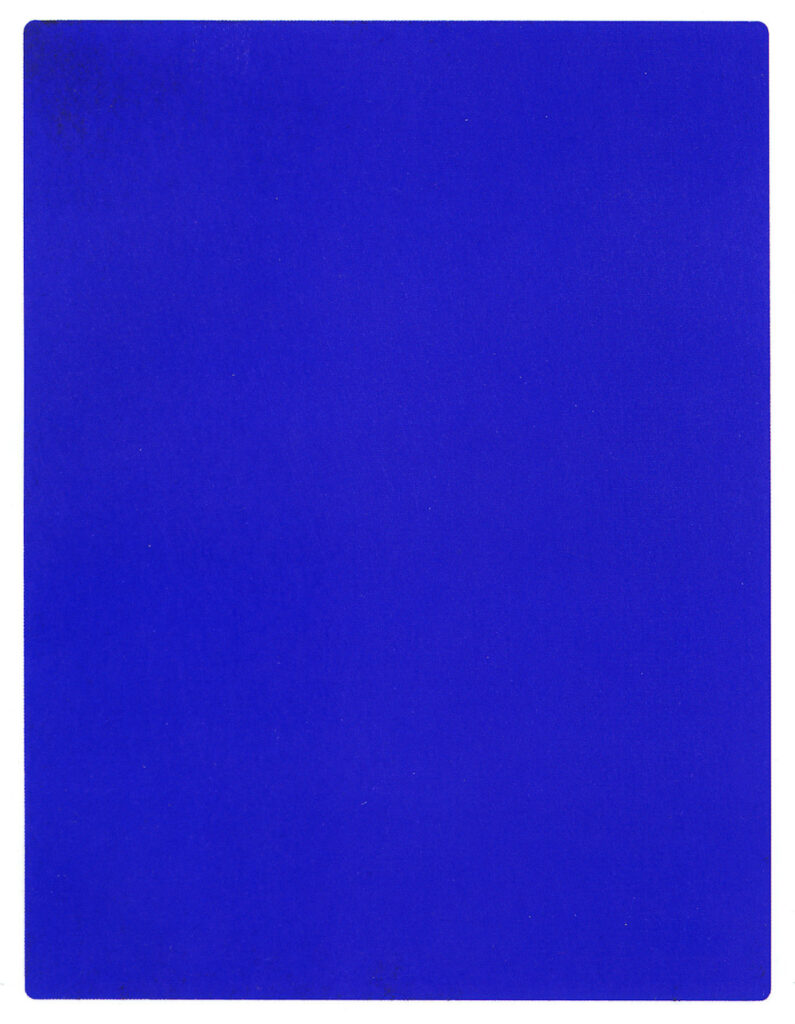
Blue is the most popular colour. So it seems strange that in language, literature and art blue is a latecomer among colours.
Last week I was talking about the colour Yellow which is associated with the sun, warmth, good mood and a happy chappy soul. Today I will turn to the colour Blue.
Blue is a most interesting colour. Have you noticed that blue is exceptionally rare in nature? At the same time blue is a constant in our life, because it it the colour of the sky and the water.
In language, literature and art blue was a latecomer. The reason for that is quite simple: The first known blue was made from the semi-precious stone lapis lazuli. But only 3,000 years ago did people discover the valuable mineral in Afgahnistan. From there it was exported to all parts of the ancient world. For instance, in Egypt it was used for jellery and for prestigious works as the face mask of the King Tutankhamun (1341–1323 BC) whose eyes surrounds and eyebrows were painted with that pigment. You can imagine that the cost of importing lapis lazuli by caravan across the desert from Afghanistan to Egypt was extremely high.
So, lapis lazuli was a luxury material and therefore and statues symbol. However, blue was not only used because it was expensive. Its symbolic meaning was equally important. Blue represented the sky and the sky in return is the realm of the gods and divinity. In the case of Tutankhamun, the use of lapis-lazuli identifies him not only as a prestigious individual but also as an entity that will reincarnate after his death into a supreme being and will reach a higher level of existence.
The idea of blue as the colour of divinity, holiness and devotion can be found in all cultures.
Take India as an example: many gods, especialla Shiva and Vishnu, are represented with a blue skin and in the Old Testament the colour blues is used extensively to describe the various hangings in the holy places. In Christian art since the Byzantine time the Virgin Mary is usually represented in blue garments.
On a practical level, it made it easier for the beholder to identify the Virgin – or holy figures in general – right away.
On a psychological level, blue is a colour that enhances contemplation and meditation. Especially in devotional images is the colour blue important as it hightens the austere and quiet character of the work: A wonderful example is The Virgin and Child in a Rose Arbour by the German painter Stefan Lochner. The delicate figure of the Virgin is dressed in a deep blue garment on which the Christ Child clearly stands out. The doll-like angels serenade the Virgin and offer fruits to the holy baby boy. Above, you recognize God the Father who watches over them. The list of beautiful renderings of the Virgin is endless. Take Boticellis Virgin for instance. In contrast do Stefan Lochner does the Virgin wear a light pink dress that hightens her sweet and tender manner. But the cloak, which she wears over her fine dress, comes in a pure and luminous blue.
Pure and luminous blue is a keyword that brings me from devotional images to one of the most unique artist: Yves Klein (1928 – 1962). He was a painter, a philosopher, a judo master, an utopist, a dreamer – you name it.
Yves Klein grew up in Paris and in Nice, the capital of the Cote d’Azur – The Blue Coast. There, he often experienced tht natural phenomenon that the sky and the sea merge to become one big blue image.
One day in 1946, Ives Klein and his friends- the artist Arman and Claude Pascal, who was to become a composer, lay on a beach, and decided to divide the world between themselves: Arman chose the earth, Pascal, the air and the wind, while Klein chose the sky, which he then proceeded to sign as his first proper art work. At this point blue became his trademark and he used it for most of his works thereafter. But why blue? Because blue was a reminiscence of the sky; the realm of infinity, of a boundless space and utter freedom. Freedom was his life concept. He did not accept any limits. With 19 he took up Judo which was extremely exotic at this time. With 25 he studied Japanese and went to Japan for this forth Dan (the highest black belt). Here he met with the philosophy of Zen-Buddhism and was fascinated by the concept of purity and totality. On his return he worked on the perfectly pure blue. Together with his pharmacist Edouard Adam in Paris Klein created the so-called „International Klein Blue“ (IKB) – a wonderful ultramarine blue, mixed with a resin called Rhodopa.
The result: iconic blue Monochromes which he singed “Yves, le Monochrome”. They are just colour: No composition, no design, no thought, no line, no visible brushwork, none distraction. He wished to overcome tradition, the ego, matter – in short: he wished to overcome any obstacles. For that goal he sacrifices even his health. Once he jumped out of the window – he survived but severely hurt his shoulder. He tried to prove that he is capable of establishing a harmonic unit with him and the air in order to overcome gravity.
Throughout his short life he tirelessly tried to fulfill his desire – to become one with the universe. He tried so hard that he suffered a heart-attack in 1962 – age 34. Just four month after the first attack he suffered a second one. His physisist warned him to slow down, but Klein even stepped on the gas. In his diary he wrote: “Now I want to go beyond art – beyong sensibitliy – beyond life. I want to enter the void. My life should be like …a continuous note, liberated from beginning and end, bounded and at the same time eternal, because it has neither beginning nor end…”
That reminds me of Max Beckmann. He once said: Death is not the end it is the beginning of something new. Yves Klein certainly believed in it and blue became the symbolic colour for the endless possibilities in the realm of the unknown.
We return to Japan where Yves Klein took great inspiration from and turn our gaze to the painter Katsushika Hokusai (1760 – 1849). He is probably the best known Japanese artist in the western world.
One of his most famous works it “The Great Wave of Kanagawa” (1829/30). As the title implys, the prominent feature is of course the extended wave as it is just about to break. At first glance one hardly notices the three fisher boats in the forground, which are threantend by the monstrous wave. At the time the work was painted Japan underwent – just like the rest of the world – great changes. The Edo-time – a 250 years period of complete isolation – became porous. “The Great Wave” can be understood as symbolic of a changing Japanese society. A little more than 20 years later, Japan saw indeed many upheavels. Political pressure pushed Japan to open up its ports and exports to foreign nations. As a result of it, a wave of Japanese prints flowed across Europe and strongly influenced artists Vincent Van Gogh, James Abbott McNeill Whistler, Claude Monet, Egon Schiele, Gustave Klimt, and many more.
The work exerted such a great impact in Europa that we shall linger a bit longer on “the Great Wave” and turn our attention to paint. Hokusai used Prussian Blue to depict the wave. Why a German colour? For the explaination we have to go back in time. During the 17th and 18th centuires, chemists in the western world preoccupied themselves with the creation of synthetic blue pigments, in order to avoid the huge expense of importing and grinding lapis lazuli and other minerals. Then, in 1709, the German Diesbach – a druggist and pigment maker – accidentally discovered a new blue made of iron sulphides, potassium and other ingridiens. He called the new colour Berlin blue – later it became known as Prussian Blue.
The Rococo painter Antoine Watteau used it an early as 1710. In the 19th century, Prussian Blue was popular among the Impressionist – but not only: Japanese artists such as Hokusai and Hiroshige used it in loads of works. The colour was imported into Japan through the port of Nagaski. It was quite expensive but the advantage was that it did not fade like traditional Japanese blue pigment.
So, Japanese artists used western pigments and the western avant-garde artists heavenly influenced by Japanese works of which „The Wave by Hokusai is a prime example. This is what I call a fruitful cultural exchange.
0 comments on “I spy with my eye something with BLUE”