
Hubertus Reichert
Hubertus Reichert (*1952, Lüneburg) lives and works in Munich. From 1974 to 1979, he studied at the Academy of Fine Arts in Munich. Right after his degree he exhibited in numerous group and solo exhibitions and received many awards, such as the DAAD-scholarship for New York, the Bavarian State award for fine arts, the annual award of the City of Munich or a scholarship of the Bavarian State for New York.
For Hubertus, art is a subject to be examined and explored. He is a passionate painter who shows and celebrates the traits and sensorial properties of his medium. At the same time he views art from the outside, being an observer and commentator upon its role and nature.
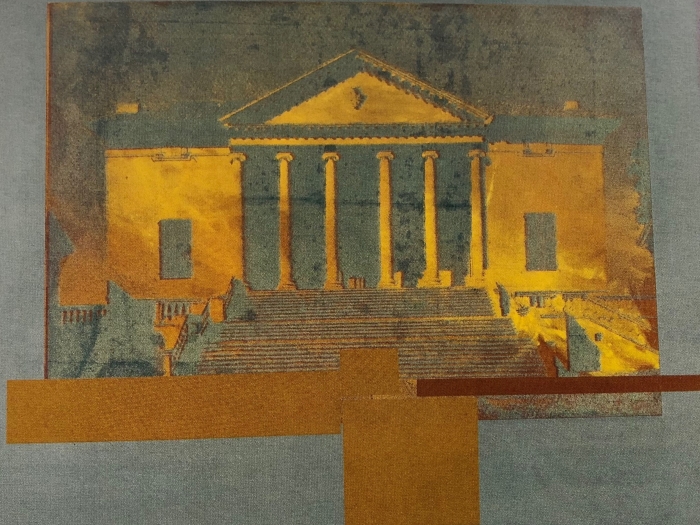
The latest edition “Palladio” wonderfully exemplifies that. The ongoing series is a never-ending homage to Andrea Palladio, the great Master of Renaissance architecture. Hubertus visited the beautiful Palladio Villas around Vicenza in the early 1990s, which triggered a deep fascination. He took photographs which later became the source for the screen prints.
Artvantgarde presents an edition featuring the “Villa Badoer” which was built between 1556 and 1563.
In his work, the Villa virtually sits on a foundation of geometrical forms and shapes. They cite Russian Constructivism, which emerged at the beginning of the 20th century. Those familiar with it might recognize the famous square of Kazimir Malevich.
Palladio and the Russian constructivists – these are two fundamentally important positions in the history of art and architecture, which are separated by place, time and approach.
The first one brings to mind keywords such as “Italy, 16th century, looking back in time for inspiration, poised and elegant” whereas the Constructivists are connected with “Russia, early 20th century, provocative modernity, striving for a revolution in art”.
On the surface they seem worlds apart. But in the hands of Hubertus they form a harmonious unity.
Hubertus fuses the two styles to draw our attention to the fact that the Renaissance Master and the young Russian avant-garde artists have astonishingly much in common. The comparison is most interesting because it reveals important aspects of the general nature of art, its motivations, aims and goals.
So, let us take a closer look and turn to Palladio first:
Andrea Palladio (1508 – 1580) was undoubtedly one of the most influential architects in history. His marvellous buildings such as the cloister and church San Giorgio Maggiore in Venice or the villas of the Veneto have become icons and his treatise “Four Books of Architecure” – published in Venice in 1570 – right away became a “Bestseller” and he has been the voice of authority in architectural design ever since.
Palladio meticulously studied the treatises and architectural remains of antiquity. After years of assiduous research, he had gained a profound and extensive understanding of the thinking, the aims and methods of the architects of Classical Greece and Rome: their technical refinement and practical use of materials, the ideal measurements and balanced proportion, the meaning of the decorative elements and the symbolism of the style of the column system.
Palladio achieved such mastery that he was able to freely adopt the classical canon to fashion his own distinctive style. It is noteworthy that his style became a Style (with a capital S): “Palladianism”.
Throughout the centuries, numerous architects have been captivated by the noble simplicity and calm grandeur of Palladio’s buildings. They can be seen as three-dimensional manifestations of subtlety, serenity, poise and dignity. Palladio’s name is a synonym for sophistication and timeless beauty.
More importantly, however, is that his fame rests very much on his attitude! Palladio was not just an architect but an intellectual and humanist – his world was very much grounded in the idea that the purpose of architecture is to express human virtues. Each villa can be understood as an ‘entity’ which reflects Palladio’s idea of how modern man and modern civilization ought to be: ordered, measured, collected and calm, refined, cultured, poised and dignified! For Palladio, the ideas of humanity, civilization and reason were guiding principles and he strongly believed in the power of art and architecture to uplift human spirits and elevate the mind.
This idea of art as a bridge leading to a more civilised form of existence brings us to Russian Constructivism which evolved around 1912 as a kind of Post-Cubist art movement.
In stylistic terms, Russian Constructivism seems miles apart from Palladio. Yet, there are common traits of thinking: Just like Palladio, the Constructivists saw art not merely as a mirror of society or a means to please the eye. They trusted fully in art to be a motor that could help change society for the better.
The modernist aims of the Constructivists were very much fired and fuelled by the events that led to the Russian Revolution of 1917. The main proponents of this avant-garde movement – such as Wladimir Tatlin, Kazimir Malewich, Alexander Rodchenko or El Lissitzky – were eager supporters of the Bolshevists’ vision of a future in which people would have a high standard of living, based on advanced technology that would provide a whole range of opportunities for all individuals.
Just as Lenin was vigorously breaking away from the suppressive imperialist past, the Russian Constructivists were determined to erase all known artistic traditions and outdated conventions. It was a real tabula rasa! An important concern was to create a new artistic vocabulary that could match and translate the political vision of the fledgling Soviet Union.
Take the dynamic free-flowing shapes for instance, which are so characteristic of the Constructivists designs: They express the new freedom of people who were freed from the heavy burden of the tsarist system.
Another example is the obvious avoidance of any personal expression and style. The Constructivists deliberately created a universal and objective visual language that was able to articulate Lenin’s dream of a collectivist society.
The government understood very well the political endeavours of the avant-garde , which resultedin Lenin’s culture minister, the writer Anatoly Vasilyevich Lunacharsky, declaring “Constructivism” the official sartistic tyle. It was to cover every area of daily life: from fashion to graphic design, from household items to architecture, etc.
In detail that means: Lenin was speaking to the masses from a Constructivist-designed platform; people were to enjoy themselves at Constructivist films and plays. State buildings were to be constructed of glass and steel so that they should embody the modernity and transparency.
The bright light of Russian Constructivism tragically ended in 1932, when Stalin came to power and banned the activities of
the Russian avant-garde.
Tradition – Innovation, Past – Future, poised – provocative: There are worlds between the Constructivists and Palladio. Yet they had a similar motivation and were driven by a common desire, which is: to build the foundation of a better civilization. The Renaissance man and the Russian avant-garde strongly believed in art as a means by with to elevate the mind, liberating the individual, stimulating a change of society and encourage a brighter climate of social thinking.
Furthermore, both had an enormous afterlife: The thinking that lay behind Palladio’s endeavours inspired many other architects. Especially the British were great admirers and introduced Palladio’s ideas to America. Notable examples of “Palladianism” are St. Paul in London, the villa of Thomas Jefferson, the third president of the USA, and the White House in Washington, DC. Russian Constructivism also continued to live on in the Dutch deStijl, and the German Bauhaus. When the latter was shut by the Nazis, the ideas of the Bauhaus were carried into the world and with it the core of Russian Constructivism.
Hubertus Reichert pays tribute to these two artistic traditions by fusing them together to form a convincing stylistic harmony. The edition “Palladio RC” reveals the connection of art forms that spans centuries: It is the desire to find ways of improving the quality of life for individuals and societies.
Nikolai Punin, art scholar and co-founder of the Department of Iconography in the State Russian Museum, found the right words for why art matters. In 1918 he wrote: „Art does not ornament, …..does not serve as a means of enrichment – art augments human experience, deepens and broadens knowledge of the world, of man and of their mutual relationship“.
0 comments on “Hubertus Reichert”